
A Year in Review
The Kids Are Not Alright, Actually (And that’s ok, lets talk about it!)

It’s been a big year in politics. From Trump 2.0 to Zohran’s victory to Justin Trudeau dating Katy Perry – 2025 was full of shocking headlines. Through it all, young people have remained an essential and powerful force in determining this year’s political outcomes, culture, and trends. As we head into 2026, we’re reflecting on what we’ve learned this year and making some predictions for the year ahead.
Before we get into it, we want to take a moment to announce that NextGen America has a new Executive Director, Arianna Jones! Arianna has most recently partnered with the International Association of Sheet Metal, Air, Rail and Transportation Workers (SMART) on strategies to educate and mobilize members around key issues and previously served as Deputy Campaign Manager for Senator Bernie Sanders’ 2020 presidential campaign and as Deputy Communications Director on his 2016 run. She also served as Chief of Staff at NextGen America during the 2024 cycle. Stay tuned for a Q&A with Arianna early next year! But for now, let’s get back to it…
If 2025 taught us anything, it’s that the kids are not all right, actually. Now, we know that sounds depressing, but it’s really important to engage with young people’s fear, pain, and confusion right now. From our polling we conducted in the spring with Tulchin, to our conversations in-person on college campuses and online with young people throughout the year, it is clear that young people are struggling. Not only financially, but emotionally. This frustration, cynicism, and sadness isn’t showing up in a vacuum – it’s a symptom of systems and politicians that have failed young people for their entire lives. Young people are craving community, support, and action on the issues most important to them.
A lot has happened this year (DOGE, longest government shutdown, continued school shootings, attacks on free speech, and Charlie Kirk’s assassination, to name a few), and we couldn’t possibly explore the root of every youth story if we tried, but we are going to explore what we know for sure. From our conversations with young people this year, we have some important takeaways:
There has been a long-held belief that young people are apathetic and not attuned to what is going on in the world. In our work this year, we found the opposite to be true - young people want to share their stories and express their frustrations with those willing to listen.
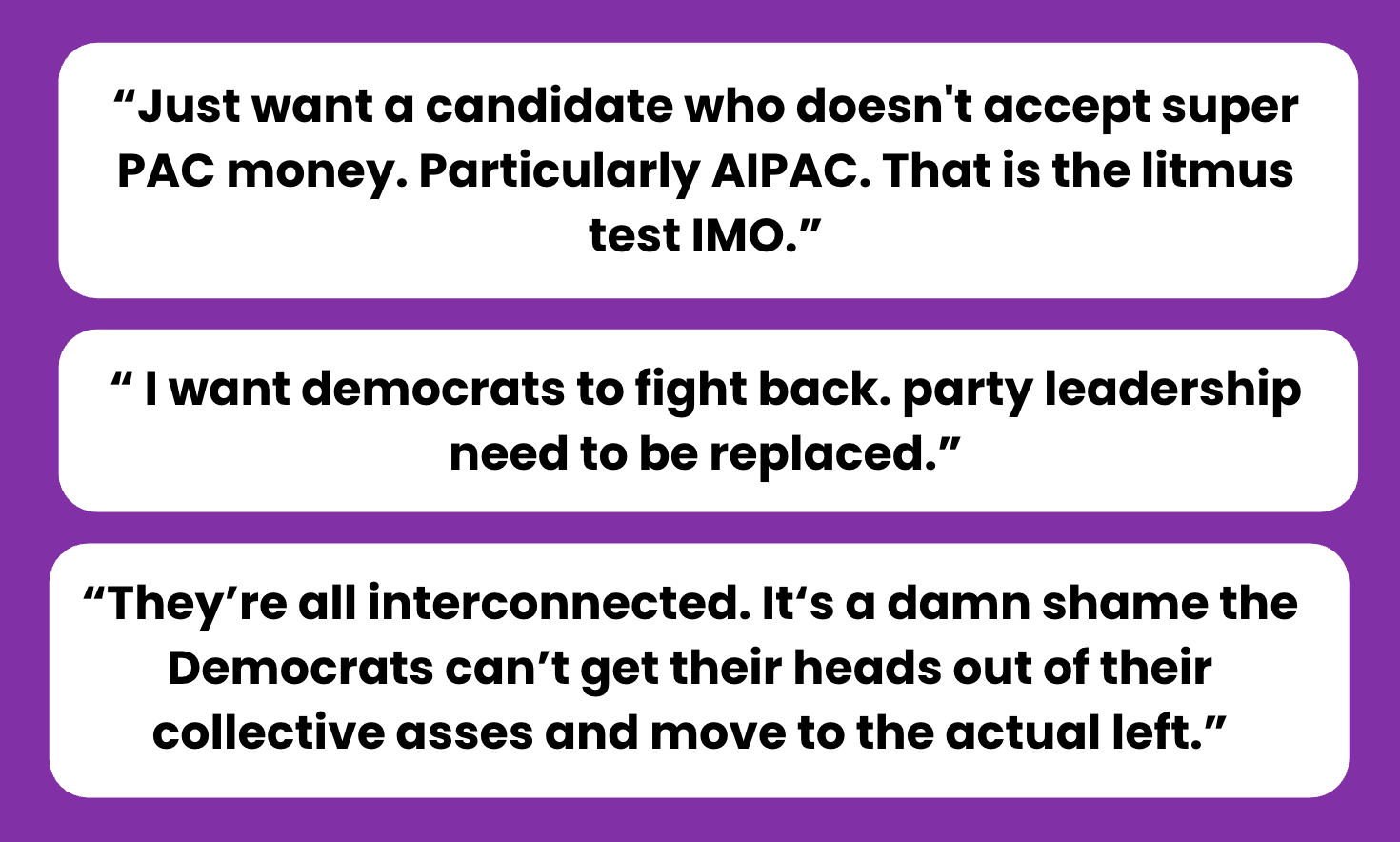
This fall, our Distributed team talked with nearly 6,000 young people between the ages of 18-29 over text or phone and asked them what their top issues are right now. A majority listed several issues and could not name just one – with many people mentioning how they view the issues as intertwined. A few quotes from these conversations are below.
What issues are top of mind for you right now?
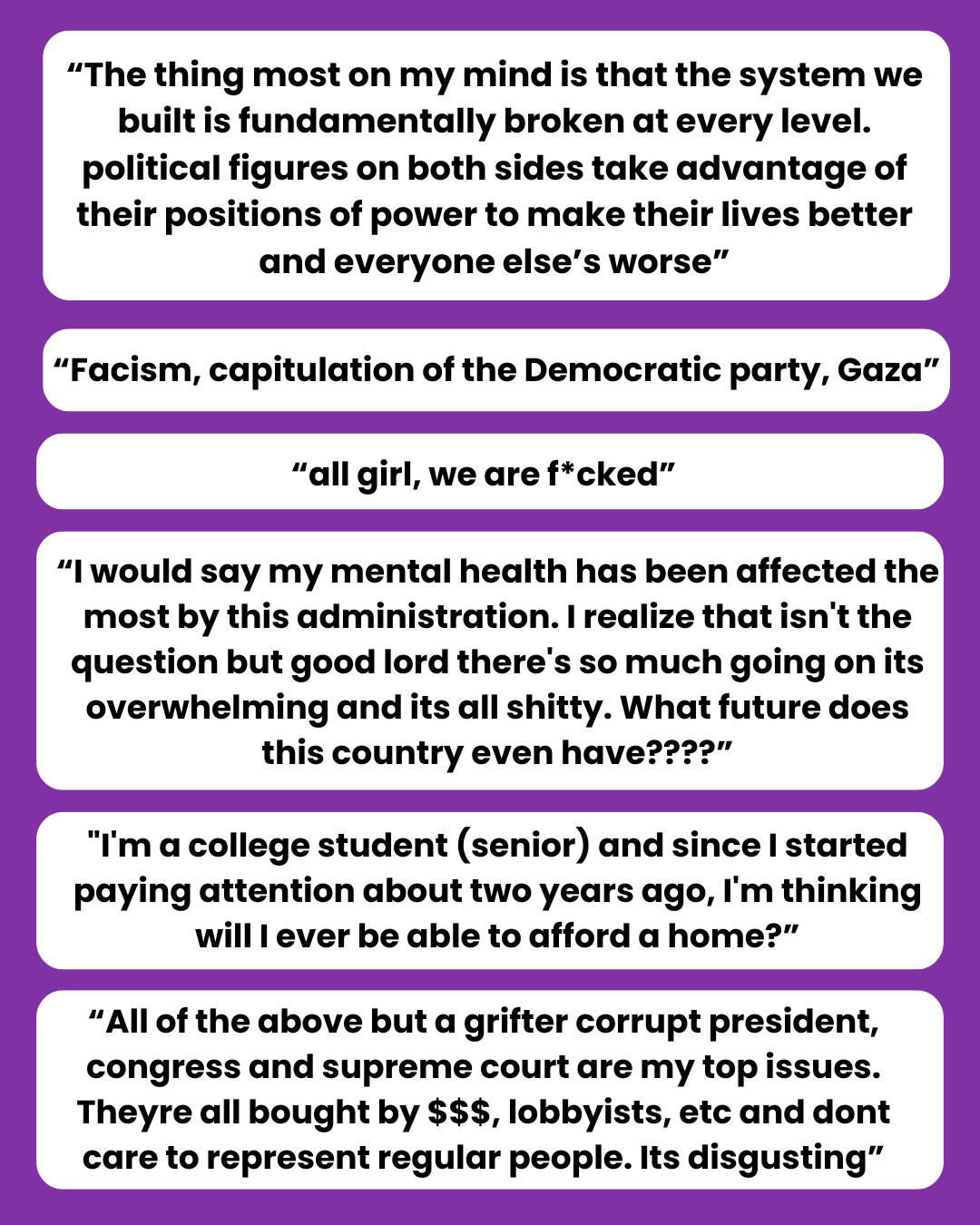
When we initially started this campaign, we didn’t expect to have such a high response rate. These calls and the stories we collected show that young people will talk on the phone, and a lot of them are looking for a channel to vent their frustrations about current events and what it means for their futures.
These feelings of frustration and craving community manifested in campaigns like Zohran Mandani’s, who helped organizers not only build political power, but helped build social and community power, too. His campaign was focused on connection, and along the way, people became friends, built community irl, and discovered how collective action can build power. Young people respond when our elected officials speak to their interests, values, and top issues. While Zohran’s campaign cannot (and should not!!) be applied broadly to all campaigns for the rest of eternity, we should note that when young people feel engaged, listened to, and a part of something bigger than themselves – they will show up.
Economy/Affordability and Democracy are Top Issues
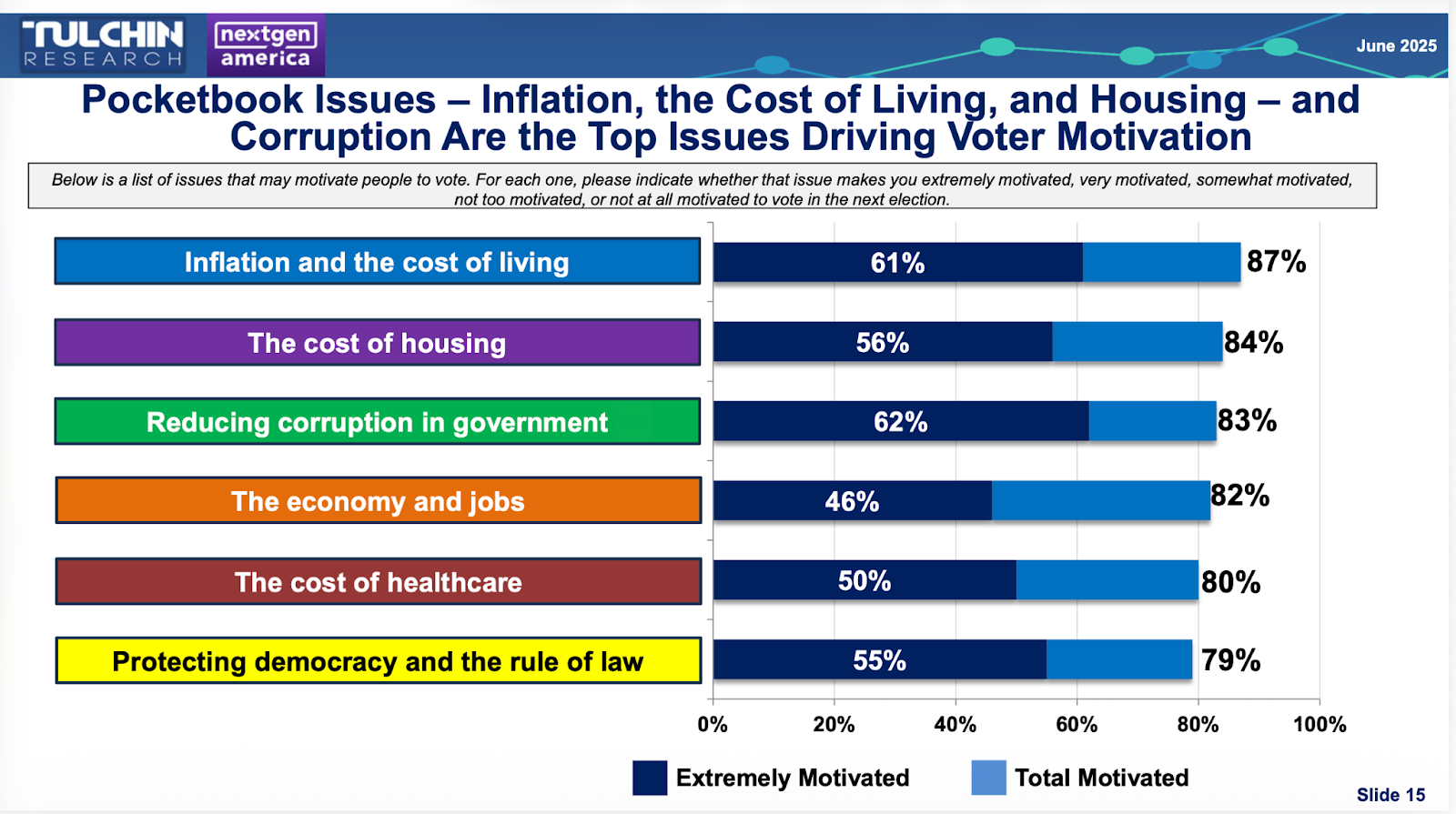
We talked about our polling a lot this year, and for good reason - the same themes keep resonating. Our poll from this summer found that young people’s top issues come down to affordability: inflation and the cost of living, the cost of housing, the economy and jobs, and the cost of healthcare. And right after economic issues? Young people named “Protecting democracy and the rule of law” as their top issue. These two topics aren’t necessarily separate for young people.
As our Tulchin poll showed, and as a recent UChicago poll explored further, young people are extremely concerned about corruption in politics, and they understand how this corruption is making their lives unaffordable and unlivable.
In our most recent series of calls and texts to young people, the economy and democracy consistently ranked as the top two issues. We went into a recent texting outreach campaign thinking the economy would be far and away the top concern, but found democracy ranked extremely high as well, with 46% of young people naming it as their top issue. Our findings are in line with new polling from the Yale Youth Poll, which found 78% of voters (and 77% of 18-34 y.o.) mentioning Democracy as the issue deciding their vote.
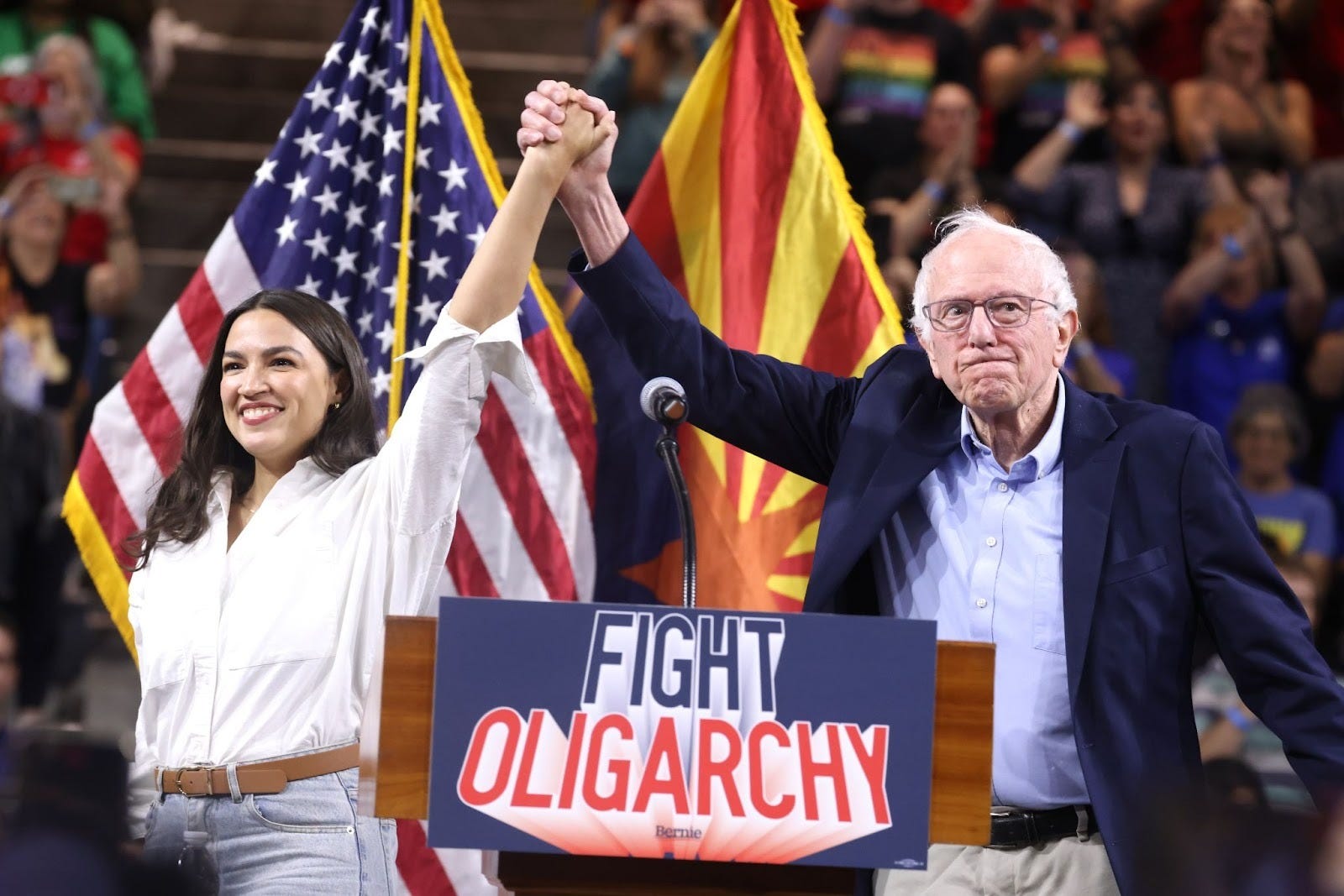
These concerns were embodied in a movement when Bernie and AOC went on their ‘Fighting Oligarchy” tour this year. Their progressive, economic populist messaging resonated with young people all across the country. For young people, there’s a direct correlation between democracy/the diminishing power of their voice, and big money controlling our politicians. When politicians are bought and paid for by special interests (real estate, healthcare, the NRA, Big Oil, etc), it results in leaders who don’t actually care to improve people’s lives on these issues. Young people are connecting the dots and understanding how our systems are failing working-class people. Despite this frustration, our poll from earlier this year (and others!) shows that a majority of young people still believe in the power of their vote to create change.
To increase participation by young people in 2026 and beyond, it will require action from leaders that actually aligns with the issues young people care about. Young people know their voice has power, but they want to see their electoral support translate into policy changes that improve their lives.
Young People are REALLY Frustrated with Elected Leaders on Both Sides
Pundits on both sides of the aisle will be quick to tell you that one party has ‘won’ young people, but that is simply not the case. Over and over again, whether in polling or in conversation, young people state strongly that they do not identify or strongly support either elected Democrats or Republicans. In fact, they actively distrust elected officials on both sides of the aisle. In our poll from this summer, we found this to be true, too.
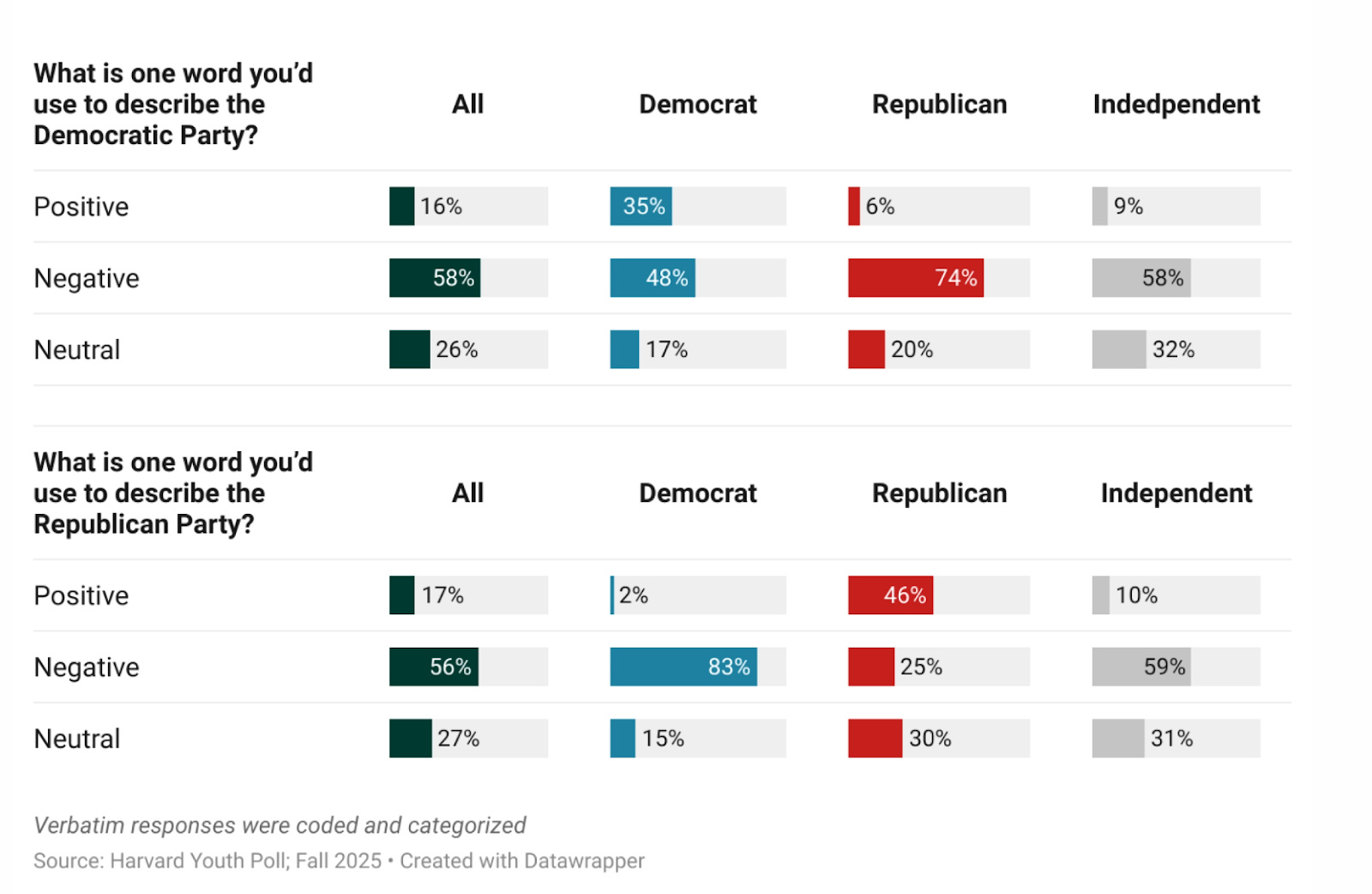
In Harvard’s recent youth vote poll, the findings were the same. As Harvard’s Youth Poll summarizes, “Young Americans rate President Trump and both major political parties poorly, offering overwhelmingly negative descriptions of Democrats and Republicans alike — and while Democrats lead for 2026, that support stems more from caution than genuine enthusiasm.” In Harvard’s Poll, when asked for one word to describe each party, 58% of young people polled used a negative word for Democrats — most commonly “weak” — and 56% used a negative word for Republicans, most often “corrupt.” Just 17% offered a positive word for Republicans (27% neutral), and only 16% offered a positive word for Democrats (26% neutral).
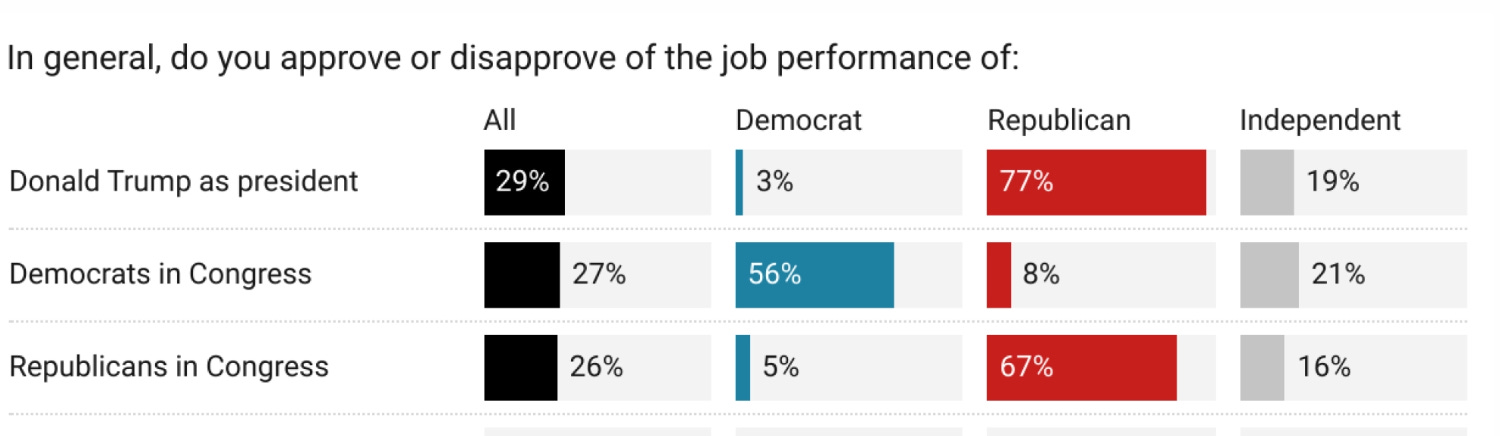
Both Congressional Democrats (27%, +4 since Spring) and congressional Republicans (26%, -3 since Spring) rank extremely poorly amongst young people in job approval.
When our Distributed team recently asked young people for their top issues under the current administration, respondents brought up politicians and parties unprompted. While a majority of respondents who listed Democracy as their top concern mentioned the President or this administration, some respondents mentioned their frustrations with the Democratic party or particular establishment/moderate Democrats on their own. Common themes include believing Democrats are not doing enough, not listening, and a dislike for any politician who takes AIPAC money.
What both the Harvard and Yale youth polls show (that is also reflected in our internal data) is that while youth support of current Republican leadership may be dropping, it isn’t automatically translating into increased support for Democratic elected officials. What that tells us is young people aren’t simply shifting their trust from one party to another; they’re withholding it altogether. This means that when it comes to the issues young people care about—affordability, healthcare, or housing—engagement and trust have to be earned through demonstrated leadership and tangible results, not assumed based on party affiliation alone.
And that’s not a failure. That’s a responsibility. It means no one gets to take young voters for granted. It also means disengagement isn’t inevitable — it’s conditional. When elected leaders invest, show up consistently, and offer something beyond a transactional ask, young people respond. When they don’t, young people leave. That’s not ideological drift. That’s rational behavior. The job now is to recognize this frustration and answer the call with real action.
What This Means for the Road Ahead
If 2025 reminded us of anything, it’s this: when elected leaders listen to young people and prioritize the issues they care about – affordability, minimum wage, healthcare and college costs, reproductive care, free speech, democracy, and an economy that works for them – that focus translates into participation.
To keep young people from feeling even more disconnected and checked out, youth organizing has to bridge the personal AND the political. Our culture values extreme individualism, and this splintering, present on social media, corporate media, and politicians and pundits alike, is designed to make people feel more isolated. Together, this isolation can result in desperation and extremism. Moving forward, organizing that disrupts these trends and faces the challenges head-on will be essential. It’s a big topic – one we’ll be unpacking in the new year, but for now….
Whew! We’ve just spent a lot of time recapping what worked, what’s resonating, and how young people are feeling. Looking ahead to 2026, we know these key issues will remain top of mind for young people as they consider how to use their voice in November, and we’re committed to fostering a space for folks to learn, grow, get involved, and vote with confidence.
We’re excited to continue this work into 2026, so stay tuned for exciting updates and plans in the new year.
On Our Minds and On Our Feeds
NGA’s team top albums of the year!! (in no particular order)
Virgin - Lorde
Princess of Power - Marina
Everybody Scream - Florence & the Machine
Ego Death at a Bachelorette Party - Hayley Williams
For Melancholy Brunettes and Sad Women - Japanese Breakfast
K pop demon hunters
RAYE
TLOAS
Something Beautiful Miley Cyrus
Rosalia “Lux”
Debi Tirar Mas Fotos - Bad Bunny
So Close to What - Tate McRae
West End Girl, Lily Alen
Three Cheers for Sweet Revenge Remaster - My Chemical Romance
Violet - LS Dunes